English-speaking clinics in Kyoto & Namba — open every day
Back to all articles

Blog

Can't Find Your Usual Meds? 10 Common Western Drugs Unavailable in Japan & How to Get Help (Part 1)

Published
Travel Health Guide

Macrobid, Vicodin, Neosporin, Pepto-Bismol — 10 common Western medications you won't find in Japan, and the Japanese alternatives doctors prescribe instead.
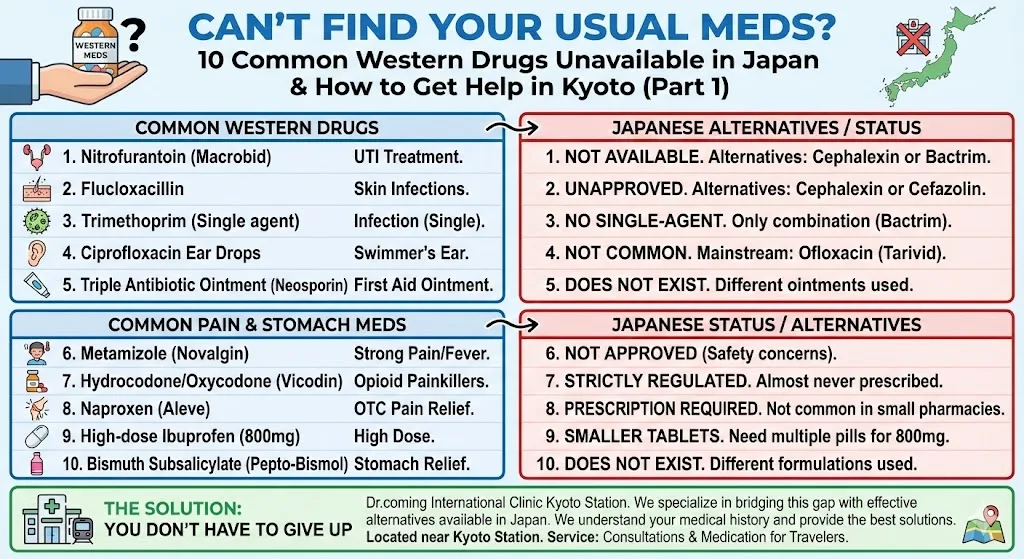
Comparison chart of 10 common Western medications — from Macrobid to Pepto-Bismol — with their availability status and Japanese alternatives

“I need Macrobid because I have a bladder infection.” “My back hurts. Can you prescribe Vicodin?”

We hear these requests from travelers visiting Kyoto and Osaka almost every day. However, unfortunately, at most Japanese pharmacies and general hospitals, the answer is often “no.”

This is not because Japanese healthcare is lacking. It is because many medications that are standard in the US, Europe, or Australia are either unapproved or strictly regulated under Japanese law.

In this Part 1, we will introduce the top 10 medications for infections, pain, and stomach issues that travelers struggle to find in Japan.

10 Medications You Might Not Find in Japan

Here is a list of common Western medications and the situation regarding them in Japan:

1. Nitrofurantoin (Macrobid)

  • In the West: The gold standard for treating urinary tract infections (UTIs).
  • In Japan: It is not available. Instead, doctors typically prescribe cephalexin or ST combination drugs (Bactrim) to treat cystitis effectively.

2. Flucloxacillin

  • In the West (UK/Aus): Commonly used for skin infections.
  • In Japan: Unapproved. We use alternatives like cephalexin or cefazolin.

3. Trimethoprim (Single Agent)

  • In the West: Often prescribed alone for infections.
  • In Japan: There is no single-agent tablet. It only exists as a combination drug with sulfamethoxazole (ST combination / Bactrim).

4. Ciprofloxacin Ear Drops

  • In the West: Famous for treating swimmer’s ear.
  • In Japan: Ciprofloxacin ear drops are not common. Ofloxacin (Tarivid) is the mainstream treatment here.

5. Triple Antibiotic Ointment (Neosporin)

  • In the West: A staple household ointment in the US.
  • In Japan: This specific 3-in-1 ointment does not exist. We use different antibiotic ointments depending on the bacteria.

6. Metamizole (Novalgin / Dipyrone)

  • In the West (EU/South America): A popular and strong painkiller/fever reducer.
  • In Japan: It is not approved for use due to concerns about side effects (agranulocytosis).

7. Hydrocodone / Oxycodone (Vicodin, Percocet)

  • In the West: Common opioid-based painkillers.
  • In Japan: These are strictly regulated by the Narcotics Control Law. They are almost never prescribed for general injuries, toothaches, or back pain.

8. Naproxen (Aleve)

  • In the West: Available over the counter (OTC) at drugstores.
  • In Japan: It requires a prescription, and many smaller pharmacies do not even stock it.

9. High-Dose Ibuprofen (800mg)

  • In the West: High-dose tablets are common.
  • In Japan: Tablets are smaller (usually 100mg or 200mg). To get 800mg, you would have to swallow a handful of pills, which often surprises travelers.

10. Bismuth Subsalicylate (Pepto-Bismol)

  • In the West: The famous pink liquid for stomach relief.
  • In Japan: This specific formulation does not exist in Japan.

The Solution: You Don’t Have to Give Up

You might be thinking, “If I can’t get my usual medicine, will I not get better?”

Please don’t worry. Even if the brand name or exact ingredients are different, effective alternatives exist in Japan for almost every condition.

At our Dr. Coming International Clinics — at Kyoto Station and at Namba, Osaka — we specialize in bridging this gap. We can listen to what medications you usually use or have used in the past, and prescribe the most appropriate corresponding drugs available in Japan. We understand your medical history and provide solutions such as:

  • “We don’t have Macrobid, but this antibiotic is the standard treatment for UTIs in Japan.”
  • “We cannot prescribe Vicodin due to regulations, but this combination of painkillers is what Japanese doctors use to manage this kind of pain.”

The final choice of medication is always made by our doctors after examining you — which is exactly what makes it safe.

You will find us right at Kyoto Station (6F Hotel Granvia Kyoto) and one minute from Namba Station Exit 6 in Osaka. If you are having trouble finding the right medicine, please come and see us.

Wondering about ADHD medication, melatonin, or other restricted drugs? Continue to Part 2: Restricted Medications & Legal Risks.

Medication and regulatory information in this article is current as of August 2026.

  1. Private ED Treatment in Japan for Travelers and Residents
  2. GLP-1 Weight Management in Japan: How Our Self-Paid Program Works
  3. Need a Doctor Near Namba Station? Direct Access from Exit 6